
Mindaugas
Lithuanian king

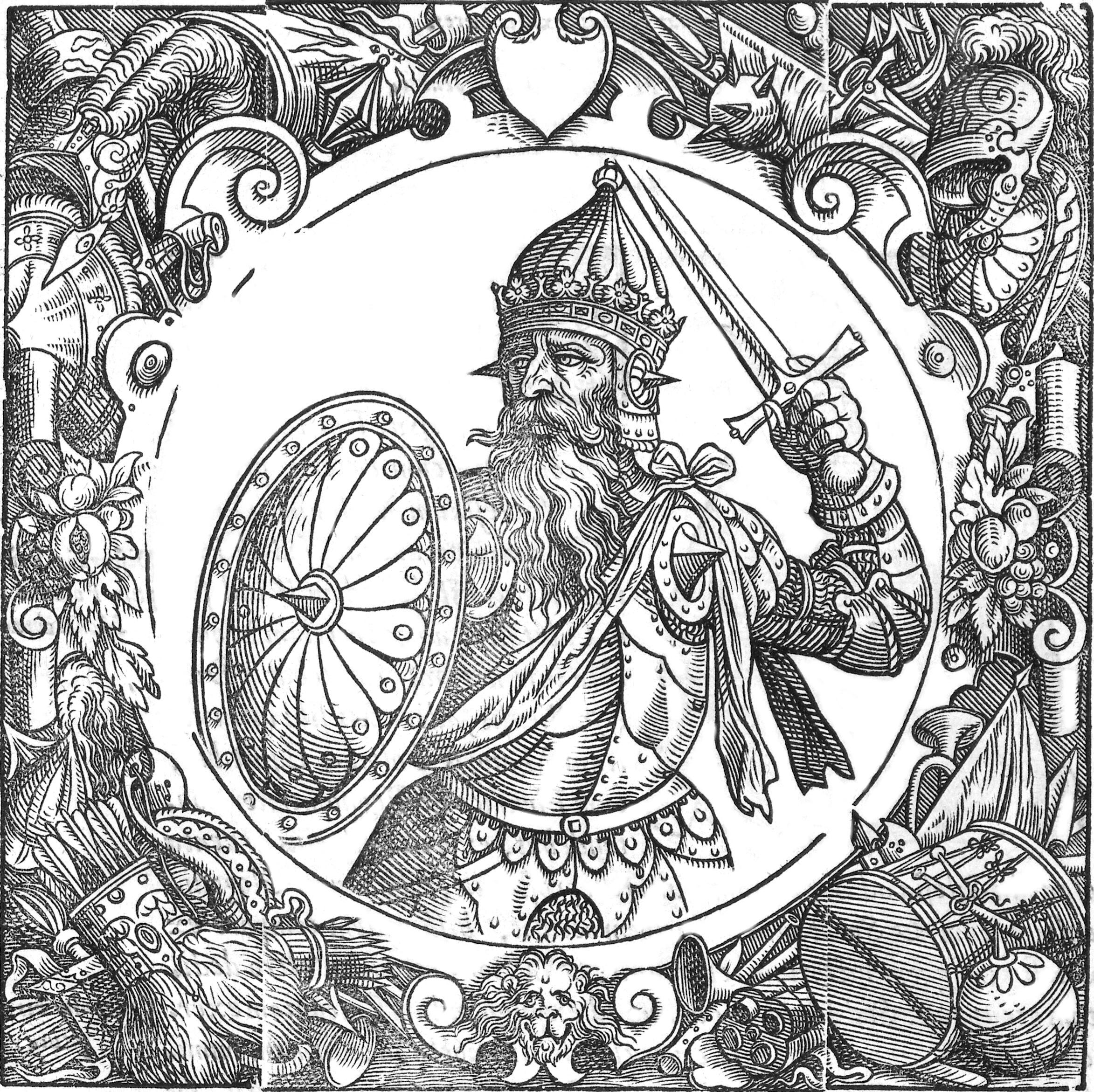
The life of Mindaugas, the first and only crowned King of Lithuania, represents a pivotal, yet tragically brief, period in the nation's history. His reign, spanning from his coronation in 1253 until his assassination in 1263, was a moment of transformation when the disparate pagan Baltic tribes were forged into a recognized medieval state. Mindaugas's legacy is defined by a central paradox: he was a unifier who built his power through ruthless division and a Christian monarch whose faith was a purely political instrument. The establishment of the Kingdom of Lithuania was not an act of peaceful consolidation but a consequence of strategic marriages, military conquests, and the elimination of rivals. His most celebrated political maneuver, his conversion to Catholicism, was a calculated gambit to gain international legitimacy and secure an alliance against a powerful coalition of his own kin and external enemies. However, the kingdom he established was profoundly fragile, a "limited-access order" reliant on his personal cunning and authority rather than a stable institutional framework.1 Upon his death, this precarious state collapsed into chaos, but not before Mindaugas's vision had laid the groundwork for the Grand Duchy of Lithuania, which would later rise to become a dominant power in Eastern Europe. This report provides a detailed examination of Mindaugas's biography, separating the attested facts from later legends and analyzing the complex political dynamics that defined his reign.
Introduction: Mindaugas, The Enigmatic Founder of Lithuania
The historical figure of Mindaugas (c. 1203 – 1263) stands as a foundational hero in the national narrative of Lithuania. As the first known Grand Duke and the sole crowned king of the country, his life marks the moment when a loose confederation of pagan tribes was united and formally recognized on the European stage.2 The annual celebration of his coronation on July 6, known as Statehood Day, underscores his enduring significance in the modern Lithuanian identity.4
The reconstruction of Mindaugas's biography presents a considerable challenge for historians due to the scarcity and inherent bias of the available contemporary sources.2 The most important accounts of his life are found in two chronicles produced by Lithuania's adversaries: the Livonian Rhymed Chronicle and the Hypatian Codex. Both of these texts are noted for their anti-Lithuanian sentiment, and they often lack specific dates and locations for even the most crucial events, such as his coronation.2 This absence of internal Lithuanian records from his reign means that Mindaugas's story is fundamentally a narrative constructed from the perspectives of his enemies and external observers. Other key documents, such as papal bulls concerning his baptism and coronation, offer a different lens, but their scope is limited to the religious and diplomatic aspects of his rule.2
Later, more expansive genealogies, such as the 16th- and 17th-century Bychowiec Chronicle, have been largely discredited by modern historians. These chronicles assert a legendary ancestry for Mindaugas, linking him to the Palemonids, a mythical noble family said to have originated in the Roman Empire.2 The inclusion of such legends in later sources highlights the need to critically differentiate between historical facts and later nationalist myth-making. The reliance on external, often hostile, accounts forces a methodological approach that involves reading between the lines and inferring Mindaugas's motives from the actions and reactions of his adversaries. The fact that his most significant diplomatic triumph—securing the papal crown on favorable terms—was recorded by the very Livonian envoys he outmaneuvered provides an example of how even biased sources can be used to understand his cunning and political skill.6
Early Life and Ascent to Power (c. 1203 – 1236)
Mindaugas was born around 1203.2 While his exact origins are debated, the Livonian Rhymed Chronicle refers to his father as a "powerful Grand Duke" (ein kunic grôß), implying a noble lineage, though it does not provide his name.2 Later, less reliable chronicles introduced the name Ryngold.2 The earliest conclusive mention of Mindaugas appears in a 1219 treaty with the princes of Galicia–Volhynia, where he and his brother Dausprungas are listed among five "elder dukes".2 This position among the most senior signatories of the treaty indicates that he had inherited a position of high status and influence within the Lithuanian political landscape.
However, Mindaugas's path to becoming the sole ruler of all Lithuania by 1236, as described by the Livonian Rhymed Chronicle, was not a peaceful succession.2 Ruthenian chronicles recount that he murdered or expelled several dukes, including members of his own family, in his drive to consolidate power.2 The historian S.C. Rowell characterizes his ascent as taking place through "the familiar processes of marriage, murder and military conquest".2 This brutal consolidation included the elimination of his presumed nephews, Tautvilas and Gedvydas, the sons of his brother Dausprungas.2
The contrast between his initial mention as an "elder duke" in a multi-polar leadership structure and his later ruthless purges of rivals reveals a fundamental transformation in medieval Lithuanian politics. Mindaugas was not simply a traditional feudal lord; he was an ambitious innovator who seized power through violence and manipulation rather than relying solely on inherited status. His method of rule, which prioritized centralized authority over traditional regional power, sowed the seeds of the deep-seated resentment among the old dukes that would eventually lead to his downfall. In this sense, his biography is not just a personal story but a chronicle of a state being born out of a violent struggle to impose a new political order on a decentralized society. The external context for this rise was a period of intense pressure from surrounding powers, including the Russians, Germans, Poles, Mongols, and the aggressive Christian military orders like the Teutonic Knights.5 Mindaugas's unification of the Lithuanian tribes was a direct and necessary response to these existential threats.
The Consolidation and the Grand Duchy (1236 – 1251)
Having established himself as the dominant ruler, Mindaugas embarked on a period of territorial expansion in the 1230s and 1240s, extending his domain into regions southeast of Lithuania proper.2 He brought Black Rus' (Navahrudak, Gardinas) and the Principality of Polotsk under his influence.1 It is notable that chronicles do not mention any major battles for the acquisition of these lands, suggesting that Mindaugas's success was often achieved through cunning political maneuvering and diplomacy rather than brute force alone.8
However, his hold on power was never absolute and was constantly challenged by internal and external forces. In 1249, a major civil war erupted when Mindaugas attempted to seize the lands of his nephews.2 A powerful coalition formed against him, uniting his own relatives—Tautvilas, Gedvydas, and the Duke of Samogitia, Vykintas—with the powerful Livonian Order and the princes of Galicia–Volhynia.1 This alliance of his pagan relatives with Christian crusaders, their traditional enemies, against Mindaugas is particularly revealing. It demonstrates that the political rivalries and the desire to restore traditional power structures among the dukes were so profound that they were willing to overlook religious and cultural animosities to defeat a common foe.
This internal conflict occurred at a time of severe external threats, with the Mongols destroying Kiev in 1240 and invading Poland in 1241, while the Christian military orders continued their relentless expansion along the Baltic coast.2 Mindaugas's survival depended on a radical political re-alignment. The Lithuanian victory at the Battle of Saule in 1236 had temporarily stabilized the northern front against the Livonian knights.2 However, the continued encroachment of the orders and the overwhelming coalition against him placed Mindaugas in an untenable position. It was in this context of existential crisis that his decision to convert to Catholicism must be understood. It was not a religious awakening, but a desperate and pragmatic political gambit to break the alliance of his rivals and gain a powerful new ally in the form of the Livonian Order and the Papacy, thereby legitimizing his rule in a way his pagan opponents could not.8
The Conversion and Coronation of a King (1251 – 1253)
The most pivotal and debated moment in Mindaugas's life was his conversion to Roman Catholicism in 1251 and his subsequent coronation.2 This act was a strategic decision aimed at gaining an alliance with the Livonian Order, a long-standing antagonist, and overcoming the internal opposition from his family and other dukes.2 The primary objective of this baptism was the crown, which would grant him international recognition and legitimacy.6
Mindaugas's diplomatic skill was evident in the negotiations that followed. Through his envoy, Parbus, he presented his own terms directly to Pope Innocent IV.6 To the astonishment of the Livonian envoys who acted as intermediaries, the Pope accepted Mindaugas's request, which was more favorable to Lithuania than to the Order.6 This diplomatic achievement was crucial, as it allowed Mindaugas to avoid becoming a vassal of the Holy Roman Emperor, a fate that had befallen other newly Christianized kingdoms like Poland and Bohemia.6
On July 6, 1253, Mindaugas was crowned the first and only King of Lithuania.3 This date is now celebrated annually as Statehood Day in Lithuania.4 The coronation was not merely a ceremonial event; it was an act that completed the formation of the state, granting it formal recognition in the eyes of the Christian world.6 Papal bulls declared that the "kingdom of Lithuania and all the lands" it controlled were now under "Saint Peter's right and ownership".15 This gave Lithuania a political status equivalent to kingdoms like England and Hungary and, crucially, eliminated the threat of being absorbed by a military order through conquest.15
The timing of this entire process was a masterstroke of geopolitical opportunism. The death of Holy Roman Emperor Frederick II in 1250 created a political vacuum, which Pope Innocent IV sought to fill by strengthening the Papacy's influence on the periphery of Europe.15 Mindaugas's request for a crown perfectly served the Pope's ambition to expand Christian influence and secure new vassals. This reveals that Mindaugas was not just a local chieftain; he possessed a rare, far-sighted understanding of European realpolitik. He successfully used the religious and political ambitions of powerful external actors to forge an independent national identity, a concept that was likely beyond the comprehension of his regional pagan rivals. His calculated conversion was not a change of heart, but a strategic tool to outmaneuver his opponents and legitimize his power on a global scale.
The Reign of King Mindaugas (1253 – 1263)
Mindaugas's ten-year reign as king was a period of state-building accomplishments, though it was marked by persistent internal and external conflicts.2 As part of his alliance with the Livonian Order, he made significant territorial concessions, ceding portions of Samogitia, Nadruva, and other lands.2 He also forged important diplomatic agreements with neighbors, including Poland, to strengthen his kingdom's position.3
Mindaugas's conversion to Christianity has been a subject of extensive historical debate, but the scholarly consensus is that it was a purely political act.2 The
Galician-Volhynian Chronicle, a source with a known anti-Lithuanian bias, asserts that he continued to perform pagan rituals and sacrifice to his old gods even after his baptism.2 The debate over his "apostasy" is crucial to understanding the political dynamics of his reign. In 1261, Mindaugas broke his alliance with the Livonian Order and may have renounced Christianity entirely, reverting to paganism.2 This shift in policy came shortly after the decisive Lithuanian victory at the Battle of Durbe in 1260, which significantly weakened the Livonian Order.16
This sequence of events—the victory at Durbe, the subsequent break with the Order, and his potential return to paganism—reveals a sophisticated, yet cynical, political calculus. The Christian alliance had served its purpose by solidifying his rule and gaining international recognition. Once the Livonian Order was no longer a major threat and his core pagan constituency, the Samogitians, had proved their military power, the Christian alliance was no longer politically expedient. The religious identity of the state was not a matter of conviction for Mindaugas; it was a strategic lever to be used and discarded as needed. This pragmatic approach extended to his personal life. After his wife Morta died in 1262, Mindaugas took her sister as his wife, despite her being married to Duke Daumantas of Pskov.7 This was not just a cruel personal act; it was a political maneuver that directly led to his assassination, as Daumantas joined the conspiracy against him.2
Assassination, Chaos, and Legacy (1263 and Beyond)
Mindaugas's reign came to a brutal and abrupt end in the fall of 1263 when he was assassinated by a conspiracy led by his nephew, Treniota, and Duke Daumantas of Pskov.2 The motivations behind the plot were a mix of political rivalry—Treniota's ambition for power—and personal revenge, as Daumantas sought retribution for Mindaugas's abduction of his wife.2 Mindaugas was killed along with his two sons, Ruklys and Rupeikis, and a late medieval tradition suggests the assassination took place in Aglona.2
Family Tree
coming soon
The assassination plunged the nascent state into a period of severe internal disorder and a temporary reversion to paganism.2 The fragile kingdom Mindaugas had forged proved to be completely dependent on his personal authority. His immediate successors—Treniota, his son Vaišvilkas, and his son-in-law Svarn—were also assassinated within the next seven years, a clear indication of the deep-seated instability.2 Stability was not restored until Traidenis became Grand Duke around 1270.2 The fact that Mindaugas was buried in the ancestral pagan tradition, alongside his horses, is a final, poetic contradiction of his life's most famous act.2
Despite the failure of his kingdom to outlast him, Mindaugas's achievements laid the crucial groundwork for the future of Lithuania. He is rightfully revered as the "father of Lithuania" and the founder of the state, as his actions in unifying the tribes, establishing a state, and gaining international recognition set a precedent that would be followed by subsequent rulers.2 The kingdom he created, while temporary, served as the foundation for the later Grand Duchy of Lithuania, which would evolve into a powerful empire stretching from the Baltic to the Black Sea.6
Mindaugas's legacy is a profound paradox. The very state he created was not robust enough to survive his own death, yet his vision and actions provided the blueprint for its long-term existence. The immediate chaos that followed his death confirms that his rule was based on personal force and cunning rather than a stable institutional framework, a "fragile limited-access order" that relied on one man.1 He was killed because the powerful dukes he had subjugated saw his rule not as a new state, but as a tyrannical personal usurpation of their privileges. His burial in a pagan manner encapsulates the contradictions of his life: a unifier who created a fragile, temporary kingdom through a series of ruthless, pragmatic choices, but whose vision of a united Lithuania endured long after his death. The enduring commemoration of his coronation on Statehood Day honors not just the man, but the powerful idea of a united and independent Lithuania that he brought into being.
Bibliography
Institutions and development in a fragile limited access order of late-medieval Lithuania, accessed September 19, 2025, https://www.cambridge.org/core/journals/journal-of-institutional-economics/article/institutions-and-development-in-a-fragile-limited-access-order-of-latemedieval-lithuania/6D5CCB036BA78EADB33842AE1C8C7078
Mindaugas - Wikipedia, accessed September 19, 2025, https://en.wikipedia.org/wiki/Mindaugas
Mindaugas Facts For Kids | AstroSafe Search - DIY.ORG, accessed September 19, 2025, https://www.diy.org/article/mindaugas
Anniversary of the Coronation of King Mindaugas - Diversity Atlas, accessed September 19, 2025, https://diversityatlas.io/events/anniversary-of-the-coronation-of-king-mindaugas/
Crowning of Mindaugas (Lithuania) | Research Starters - EBSCO, accessed September 19, 2025, https://www.ebsco.com/research-starters/history/crowning-mindaugas-lithuania
MINDAUGAS AS THE FOUNDER OF THE LITHUANIAN STATE - Lietuvos bankas, accessed September 19, 2025, https://www.lb.lt/uploads/documents/files/musu-veikla/grynieji-pinigai/200%20litas%20coin%20issued%20to%20celebrate%20the%20750th%20anniversary%20of%20the%20crowning%20of%20Mindaugas.pdf
House of Mindaugas - Wikipedia, accessed September 19, 2025, https://en.wikipedia.org/wiki/House_of_Mindaugas
State Day of Lithuania (Coronation of King Mindaugas) - CEPELINAS.EU, accessed September 19, 2025, http://cepelinas.eu/?p=520
King Mindaugas of Lithuania, accessed September 19, 2025, https://www.lithaz.org/history/mindaugas.html
en.wikipedia.org, accessed September 19, 2025, https://en.wikipedia.org/wiki/Mindaugas#:~:text=Historian%20S.C.,support%20from%20the%20Teutonic%20Order.
The Story of the Lithuanian Nation: From Pagans to Kings - Family History Foundation, accessed September 19, 2025, https://familyhistoryfoundation.com/2018/01/28/story-of-lithuanian-nation-from-pagans-to-kings/
Lithuania - Wikipedia, accessed September 19, 2025, https://en.wikipedia.org/wiki/Lithuania
Mindaugas - Internet Encyclopedia of Ukraine, accessed September 19, 2025, https://www.encyclopediaofukraine.com/display.asp?linkpath=pages%5CM%5CI%5CMindaugas.htm
King and Power - Andrius Vilius Dundzila - Lituanus.org, accessed September 19, 2025, http://www.old.lituanus.org/1990_1/90_1_03.htm
The last medieval kingdom: the coronation of Mindaugas - Orbis Lituaniae, accessed September 19, 2025, https://www.ldkistorija.lt/the-last-medieval-kingdom-the-coronation-of-mindaugas/
King Mindaugas: a powerful politician and a life full of conflicts, accessed September 19, 2025, https://www.gideo.eu/en/sightseeing-places/king-mindaugas-a-powerful-politician-and-a-life-full-of-conflicts/
King Mindaugas importance for Lithuanians - the Lithuania Tribune, accessed September 19, 2025, https://lithuaniatribune.com/king-mindaugas-importance-for-lithuanians/