
Mindaugas
Lithuanian Name

Etymology
By surface analysis, it is composed of minėti/menąs/minimas (“to mention/wisdom/fame”) + daũg (“much, a lot, capable”).[1] Reconstructed from Indo-European roots with distinct attestations in Germanic and Slavic language sources.
Some Germanist scholars who study Baltic onomastics claimed that the name Mindaugas and its Slavic cognates are of Gothic origin and that they are composed of minan (“to name, to remember, to love”) + daug (“worthy”).[2][3] This perspective disputes analyses that construct the name solely from Balto-Slavic onomastics.
Proper noun
Mi̇̀ndaugas m (feminine Mindaugà) stress pattern 1
a male given name
Declension
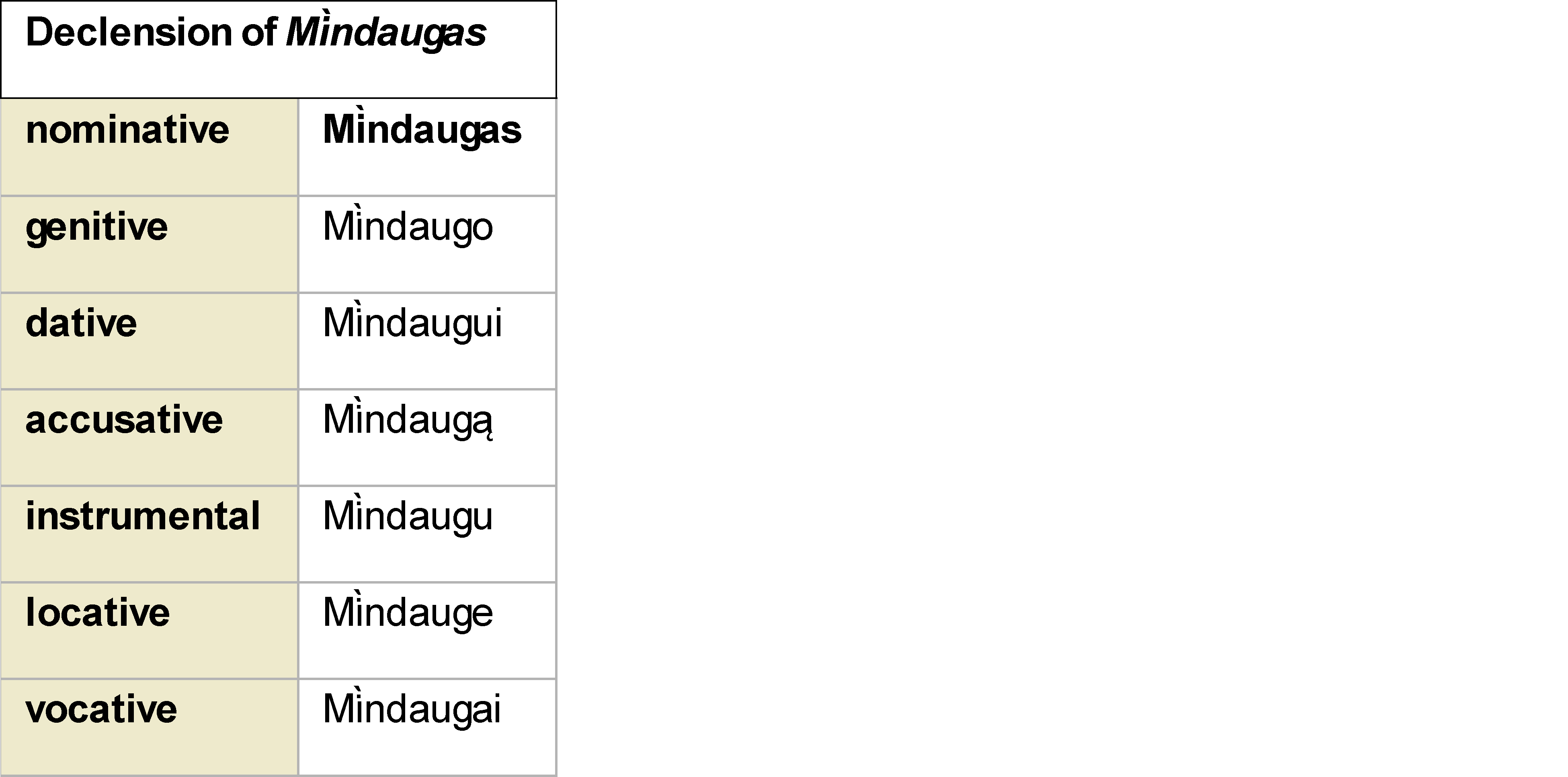
Proper noun
Mi̇̀ndaugas m (feminine Mi̇̀ndaugienė, unmarried feminine Mi̇̀ndaugáitė) stress pattern 1
a surname
Declension
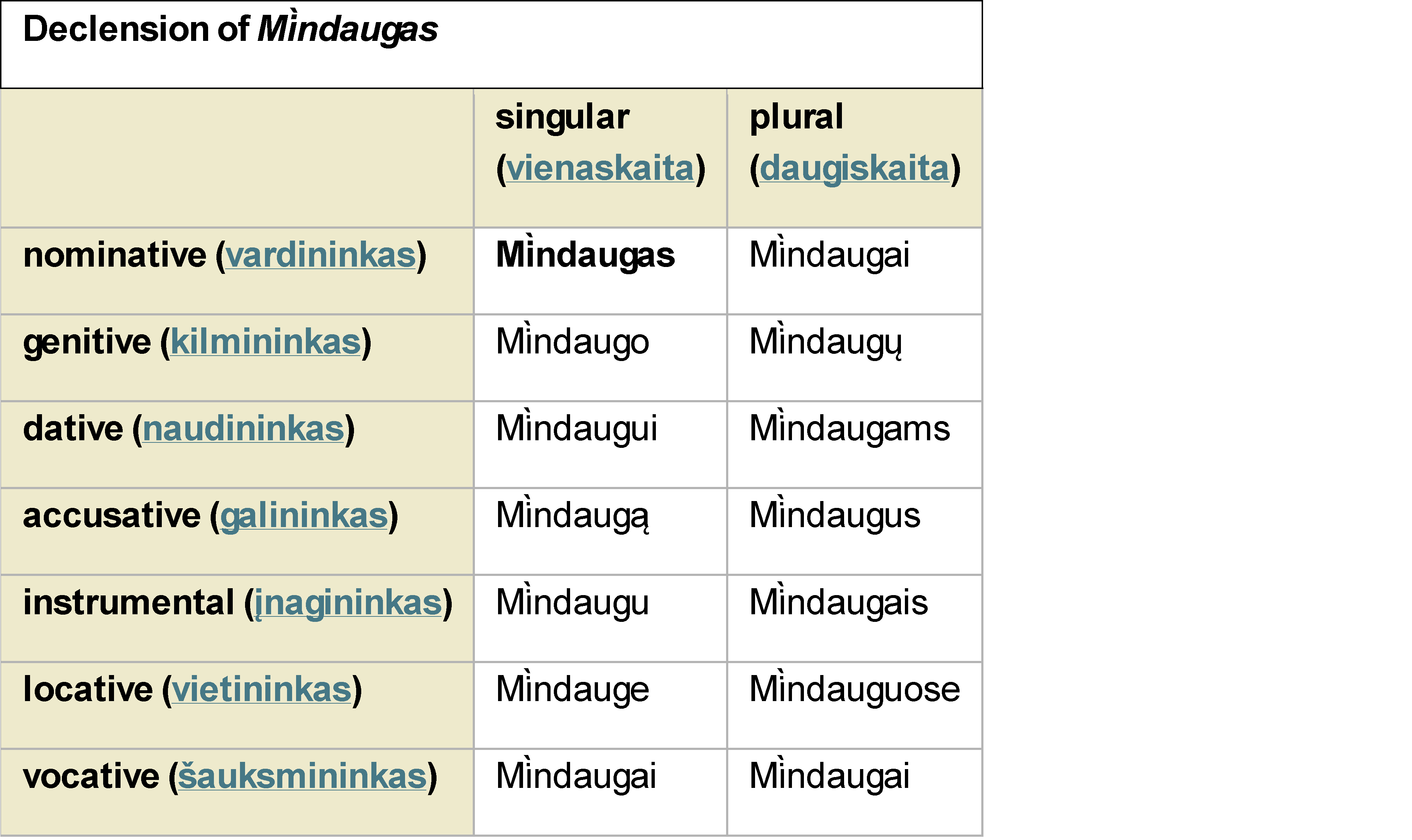
Descendants
→ Medieval Latin: Mendolphus
→ Old Ruthenian: Минъдовгъ (Mindovg)
→ Belarusian: Міндаўг (Mindaŭh)
→ Polish: Mendog
→ Ukrainian: Міндовг (Mindovg)
→ Russian: Миндовг (Mindovg)
Linguistic Assimilation
The personal name Mindaugas, rooted in Old Lithuanian, has an interesting linguistic journey. Initially, it underwent a process of Ruthenianization, transforming into the patronymic form Минъдовговичъ (Mindovgovič), which literally means "son of Mindaugas." This highlights a shift from a given name to a hereditary one.
From this Ruthenianized form, the name diffused into various East Slavic languages, each adapting it to its own phonology and orthography. In Belarusian, it became Міндаўговіч (Mindaŭhovič), in Russian, Миндовгович (Mindovgovich), and in Ukrainian, Міндовгович (Mindovgovych). This is a classic example of linguistic borrowing and phonetic adaptation, where a name's sounds and spelling are altered to fit the recipient language's rules.
Ultimately, the name came full circle, being re-Lithuanianized. It reverted to its original linguistic home, but not without retaining traces of its travels. The modern Lithuanian surname Mindaugaitis (meaning "son of Mindaugas" in Lithuanian) is the result of this re-assimilation, a parallel development to the Slavic forms. The less common variant Mindaugavičius is a direct borrowing from the Ruthenian form, a clear linguistic fossil showcasing the name's journey through Slavic lands before returning.
Known forebear: Mindaugas
Mindaugas (born around 1200, died in 1263 or 1264) was a remarkable figure in medieval European history. He's celebrated as the founder and first ruler of the Grand Duchy of Lithuania, which he led from 1248 to 1253. In 1253, he achieved an even greater feat, becoming the first and only king of Lithuania. His reign as king lasted until 1260.
Other Notable People
Stanislovas Mindaitis/Mindavičius - a boyar of the Młynka County, Podlaskie Voivodeship, who is mentioned in the census of the army of the Grand Duchy of Lithuania in 1567
Mindaugas II (1864–1928), German prince who was elected King of Lithuania in 1918 but never reigned
Mindaugas Girdžiūnas (born 1989), Lithuanian basketball player
Mindaugas Grigalevičius (born 1981), Lithuanian football striker
Mindaugas Griškonis (born 1986), Lithuanian rower and Olympic competitor
Mindaugas Kalonas (born 1984), Lithuanian football midfielder
Mindaugas Katelynas (born 1983) Lithuanian basketball power forward
Mindaugas Lukauskis (born 1979), Lithuanian basketball shooting forward and small forward
Mindaugas Malinauskas (born 1983), Lithuanian football goalkeeper
Mindaugas Mizgaitis (born 1979), Lithuanian wrestler and Olympic medalist
Mindaugas Murza (born 1973), Lithuanian nationalist politician
Mindaugas Panka (born 1984), Lithuanian football midfielder and defender
Mindaugas Piečaitis (born 1969), Lithuanian composer and conductor
Mindaugas Rojus (born 1981), Lithuanian opera baritone
Mindaugas Sadauskas (born 1990), Lithuanian swimmer and Olympic competitor
Mindaugas Timinskas (born 1974), Lithuanian basketball small forward and Olympic competitor
Mindaugas Žukauskas (born 1975), Lithuanian basketball small forward, captain and manager
Reconstruction
Balto-Slavic Hypothesis
Proto-Balto-Slavic: *Mindaugjas
Proto-Baltic: *Mi̇̀ndaugas
Lithuanian: Mindaugas
Latvian: Mindaugs
Proto-Slavic: *Minъdovgъ
Old East Slavic: *Минъдовгъ (Minudovgu)
→ Old Ruthenian: Минъдовгъ (Mindovg)
→ Belarusian: Міндаўг (Mindaŭh)
→ Polish: Mindowh
→ Ukrainian: Міндовг (Mindovg)
→ Russian: Миндовг (Mindovg)
The “Balto-Slavic Hypothesis” is the widely accepted theory that the Baltic languages (like Lithuanian and Latvian) and the Slavic languages (like Russian, Polish, and Old Ruthenian) share a common ancestor known as Proto-Balto-Slavic. While some scholars have debated whether the similarities are due to a common origin or long-term contact, the consensus in modern linguistics is that they form a single branch of the Indo-European family.
Old Germanic Hypothesis
Proto-Germanic:
Gothic: Mindaug
Lithuanian: Mindaugas
Latvian: Mindaugs
The "Old Germanic Hypothesis" is a theory that suggests many ancient Lithuanian names, especially the older two-part ones, actually come from Old Germanic languages. Gothic, being the ancestor of the modern Baltic languages, was hypothesized by Raymond Schmittlein. Many Baltists and Slavists reject this hypothesis.
Jurate Rosales’s Baltic Hypothesis
Baltic:
Lithuanian: Mindaugas
Latvian: Mindaugs
Gothic: Mindaug
Jurate Rosales's Baltic Hypothesis is a highly controversial and widely rejected theory that claims the Goths weren't a Germanic people but actually came from the Baltics.
This analysis could possibly be 100% authentic!
As the ancient Goths journeyed from their Scandinavian homeland, their path led them through territories inhabited by early Balto-Slavic peoples. This migration brought the Goths into contact with groups like the Aesti, a people who lived in what is now the Baltic region. The Goths' movement across vast stretches of land—from present-day Poland to Ukraine—resulted in a period of extensive interaction and cultural exchange with the ancestors of today's Balts and Slavs. This shared history is reflected in linguistic and archaeological similarities that hint at a deep, interconnected past.
Sources
^ “Mindaugas”, in Vardai [Names], Valstybinė lietuvių kalbos komisija [Commission on the Lithuanian language], 2010–2025
^ Дайліда А. Пачаткі Вялікага княства Літоўскага: ад стварэння да Крэўскай уніі / Рэц. С. Тарасаў. — Менск, 2019. С. 17-18
^ Morlet M.-T. Les noms de personne sur le territoire de l’ancienne Gaule du VIe au XIIe siècle. T. I: Les noms issus du germanique continental et les créations gallo-germaniques. — Paris, 1971. P. 169.
^ Gamillscheg E. Romania Germanica. Vol. 3: The Burgundians, Conclusion. — Berlin and Leipzig, 1936. P. 112.